
Looking for floor drains, gullies or area drains? Alphatek supplies stainless steel floor drains, stainless steel gullies and floor traps, PVC floor traps and area drains in SS 304/316 for projects in Dubai and across the UAE.
On UAE drawings and site orders, three names get mixed up all the time: floor drain, floor gully and area drain. They all take water off a floor, but they do different jobs, and ordering the wrong one leads to smells, slow drainage or a fitting that simply does not suit the space.
This guide explains what each one is, where each is normally used, and how they work together in a typical drainage layout.
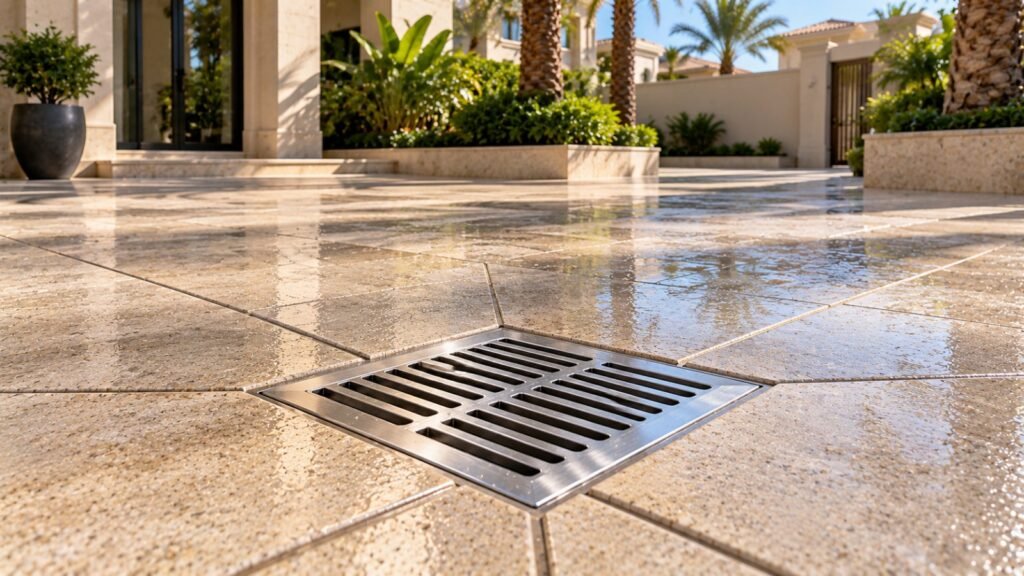
Quick answer
| Floor drain | Floor gully / floor trap | Area drain | |
|---|---|---|---|
| Main job | Collects water from the floor surface through a grate | Holds a water seal and collects water from fittings and floor drains | Collects larger volumes of water from open areas |
| Typical places | Bathrooms, showers, kitchens, plant rooms, balconies | Bathrooms and wet areas, usually under or near the floor drain | Courtyards, terraces, plazas, podiums, car wash areas, landscaped areas |
| Water seal (trap) | Sometimes built in; often relies on a separate trap | Yes, that is its main purpose | Depends on the design; often has a sediment bucket |
| Grate size | Small, usually 100 to 200 mm | Covered by a floor drain top or a cover | Larger grate for higher flow |
| Typical material | Stainless steel SS 304/316, nickel bronze | PVC or stainless steel | Stainless steel, ductile iron |
What is a floor drain?
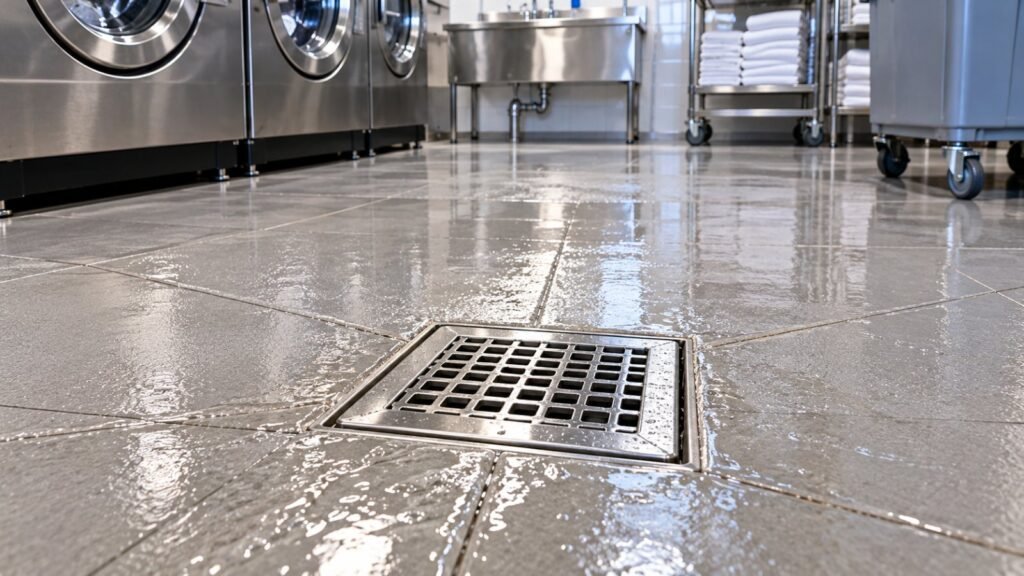
A floor drain is the visible part: a grate set into the finished floor, with a body below it that connects to the drain pipe. Water on the floor runs to it along the floor falls. In bathrooms, showers and kitchens, it is the fitting people actually see and clean.
Some floor drains have a built-in trap that holds water to stop smells. Many UAE installations instead connect the floor drain to a separate floor trap (floor gully) below the slab or in the floor build-up. Stainless steel floor drains in SS 304 suit most indoor areas; SS 316 is better for kitchens, pools and coastal buildings. See our floor drain buyer’s guide for the main types.
What is a floor gully or floor trap?
A floor gully, often called a floor trap or “nahani trap” on UAE sites, is a trapped fitting. Its main job is to hold a water seal that stops sewer gases coming back into the room. It usually has several inlets, so waste from a basin, a bath or shower and the floor drain above can all enter it before the water goes into the drain line.
Floor traps are commonly PVC, with stainless steel versions where a stronger or more hygienic fitting is needed. Our guide to gully traps vs floor traps explains how the water seal works and when the terms mean the same thing.
What is an area drain?
An area drain is built for open spaces that collect a lot more water than a bathroom: courtyards, roof terraces, podiums, plazas, landscaped areas and car wash bays. It has a larger grate and body to take the higher flow, and often includes a removable sediment bucket to catch sand and leaves before they reach the pipe, which matters a lot in the UAE.
Where people walk in heels or where wheels pass over, the grate type matters too; see heel-safe vs slot gratings. Alphatek’s area drains come in stainless steel for outdoor and podium use.
How they work together
In a typical UAE bathroom, the floor drain sits in the shower or the middle of the floor, the floor trap sits below it and also takes the basin and shower waste, and the trap connects to the soil or waste stack. Outside, on a terrace or courtyard, an area drain does the job of both: it collects the surface water, catches sediment and connects to the storm or surface water drainage.
- Bathroom or toilet: floor drain on top, floor trap below.
- Commercial kitchen: stainless steel floor drains or channels, often with baskets, connected to the grease drainage line.
- Basement or car park: floor gullies and channels with sediment buckets; see our basement drainage guide.
- Terrace, courtyard or podium: area drains or channels sized for the area and rainfall.
Which one should you order?
Follow the drainage drawing first; it shows which fitting goes where. If you are replacing an existing fitting, look at what is there: a grate with nothing under it in the floor build-up is usually a floor drain on a separate trap, a square plastic fitting with several inlets is a floor trap, and a large grate in an open area is an area drain. When in doubt, send us a photo and the drawing reference.
Frequently asked questions
What is the difference between a floor drain and a floor gully?
A floor drain is the grate and body that collects water from the floor surface. A floor gully (floor trap) is a trapped fitting that holds a water seal to stop smells and usually collects water from several fittings, including the floor drain above it.
Is a floor trap the same as a floor gully?
In UAE practice the terms are often used for the same thing: a trapped fitting, usually PVC or stainless steel, with a water seal and one or more inlets.
What is the difference between an area drain and a floor drain?
An area drain is larger and is used for open spaces such as courtyards, terraces and podiums, where much more water has to be collected. A floor drain is smaller and is used inside rooms such as bathrooms and kitchens.
Does every floor drain need a trap?
A floor drain connected to a foul drainage system needs a water seal, either built into the drain or provided by a separate floor trap, to stop sewer smells entering the room.
Which material is best for floor drains in the UAE?
Stainless steel SS 304 suits most indoor areas. Use SS 316 for kitchens, pools, wash-down areas and coastal buildings. Floor traps are commonly PVC.
Need floor drains, floor traps or area drains?
Send us the drawing or a list of drain types, sizes, finishes and quantities, and we will reply with options and a price for Dubai and the rest of the UAE. Request a quote, call or WhatsApp Justin Varghese on +971 54 466 7243, or email sales@alphatek.ae.
More in Floor Drains & Shower Drains
Stainless Steel Corner Drains – Dubai, UAE · Area Drains in Dubai & the UAE · Pit Drains & Sump Drains in Dubai & the UAE · Floor Drain Finder